Free shipping £150+ Orders
What Is Hyaluronidase Used For? A Complete Guide
So, what exactly is hyaluronidase used for? Think of it as the ultimate ‘antidote’ for hyaluronic acid (HA) – a naturally occurring enzyme that can break down HA. This unique ability makes it one of the most vital tools in both aesthetics and wider medical practice.
Its most well-known job is correcting or completely reversing treatments with HA-based dermal fillers. But it’s also a frontline treatment for urgent complications, like a blocked blood vessel, and even helps other medicines work more effectively by improving how they spread through tissues.
A Closer Look at Hyaluronidase and Its Roles

In this guide, we’ll explore everything from routine cosmetic tweaks to its sight-saving emergency uses. We’ll strip back the complex science and focus on real-world scenarios, showing you exactly why this enzyme is such a crucial safety net for practitioners and a source of reassurance for patients.
The Two Faces of Hyaluronidase
In the clinic, hyaluronidase wears two very different hats, and both are equally important.
First, it’s the aesthetic practitioner’s ‘undo button’ for hyaluronic acid fillers. Whether it’s to soften a slightly overfilled area, correct a minor asymmetry, or simply dissolve a lump, it offers incredible precision. This allows us to fine-tune results, making sure the final outcome is perfectly natural and exactly what the patient hoped for.
Second, it’s an indispensable emergency drug. On the rare occasion a filler accidentally enters and blocks a blood vessel (a vascular occlusion), hyaluronidase is the only thing that can quickly break down the blockage. Fast action here is critical to prevent tissue damage, making it a non-negotiable part of any aesthetic toolkit.
The power to reverse a procedure provides a fundamental layer of security. It shifts filler treatments from a semi-permanent decision to a flexible, adjustable process, giving both the patient and the practitioner ultimate control over the outcome.
Expanding Its Medical Reach
Beyond aesthetics, this enzyme has long-established, licensed medical uses. It’s often added to local anaesthetics, particularly in ophthalmic surgery, to help the anaesthetic spread more widely and work faster. It also plays a role in improving the body’s absorption of fluids administered under the skin (hypodermoclysis), a technique used when intravenous access is difficult.
This versatility highlights just how valuable hyaluronidase is across different medical specialties. To give you a clear overview of its capabilities, the table below summarises its main applications before we explore each one in more detail.
Hyaluronidase At a Glance Key Applications
This table provides a quick snapshot of the key aesthetic and medical applications for hyaluronidase, demonstrating its diverse role in patient care.
| Application Area | Primary Use | Typical Scenario |
|---|---|---|
| Aesthetic Medicine | Dissolving HA-based dermal fillers | Correcting overfilling, asymmetry, or lumps after treatment. |
| Emergency Medicine | Managing vascular occlusion | Rapidly dissolving filler that has blocked a blood vessel. |
| General Medicine | Enhancing drug dispersion | Helping local anaesthetics or other medications spread into tissues. |
From fine-tuning a cosmetic result to resolving a medical emergency, its function is always centred on patient safety and achieving the best possible outcome.
How the Eraser Enzyme Actually Works

To really get your head around what hyaluronidase does, you first need to understand its target: hyaluronic acid, or HA. Think of HA as the body’s natural sponge and scaffolding. It’s a sugar molecule that loves to grab onto water, creating the plump, hydrated, gel-like substance that gives our skin and connective tissues their bounce.
It’s this exact quality that makes HA-based dermal fillers so brilliant for adding volume and softening lines. The filler is just a cleverly cross-linked gel of hyaluronic acid, designed to hold its shape and provide support wherever it’s placed.
Enter hyaluronidase. This enzyme is like a highly specialised key, engineered for one specific lock. Its only job is to seek out and dismantle the chemical bonds that hold hyaluronic acid chains together.
The Biological Unlocking Process
When a practitioner injects hyaluronidase into an area with HA filler, it doesn’t waste any time. The enzyme kick-starts a process called hydrolysis, which essentially uses water to chop up the large, complex HA molecules into much smaller, simpler sugar units.
Picture the filler as a tightly woven net made of long, intertwined ropes. This net is what gives the filler its firm, stable structure. Hyaluronidase acts like a pair of precision scissors, snipping these ropes in countless places.
As the ropes are cut, the net loses its integrity and falls apart into loose strands. In the same way, the enzyme breaks down the filler’s gel structure, turning it from a firm substance back into a watery liquid. This liquefaction makes it incredibly easy for the body’s natural clean-up crew to metabolise and clear away the debris, just like any other biological waste.
The speed of hyaluronidase is one of its most critical features. It starts breaking down hyaluronic acid almost instantly on contact, which is why it’s an indispensable tool in emergencies, like a vascular occlusion, where every second counts.
Precision and Dosage: The Keys to Control
This ability to liquefy HA is what makes hyaluronidase such a versatile tool in aesthetics. For fine-tuning a result, a practitioner can inject tiny, precise amounts to smooth out a small lump or correct a subtle asymmetry. The aim is to dissolve just enough filler to get the desired outcome without over-correcting.
This isn’t a new science. In the UK, hyaluronidase has been a staple in medicine since the mid-20th century, long before fillers became mainstream. It was originally used to help drugs and local anaesthetics disperse more effectively. Decades of research have helped us establish reliable dosing protocols. For instance, a common starting point is around 35 IU of hyaluronidase for every 0.1 mL of filler, but this can vary wildly based on the filler’s properties and the specific clinical situation.
Beyond Fillers: The Temporary Tissue Loosener
The enzyme’s talents aren’t limited to just dissolving dermal fillers. Since it also temporarily breaks down the body’s own natural hyaluronic acid, it has another very useful effect: it makes the extracellular matrix—the gel-like cushion between our cells—more permeable.
This “loosening” effect is invaluable in other areas of medicine:
- Enhanced Drug Delivery: It helps injected drugs, like local anaesthetics, to spread further and more evenly through tissues, making them work better and faster.
- Improved Fluid Absorption: It’s used in a process called hypodermoclysis to help the body absorb fluids administered just under the skin, which is a lifesaver when intravenous (IV) access is tricky.
This dual action makes it a uniquely powerful tool. It’s not just an “eraser” for aesthetic treatments but also an “enabler” that helps other medical interventions succeed. And while it acts on both injected filler and natural HA, our bodies are incredibly efficient at replenishing their own supply, usually restoring the tissue to its normal state within a day or two.
Understanding this dual role is key to appreciating its importance in modern medicine. And while hyaluronidase is the go-to for hyaluronic acid, you may be interested in other enzymatic treatments for different targets. You can learn more about collagenase in our detailed guide.
Correcting and Reversing Dermal Fillers
In the world of aesthetic medicine, we celebrate hyaluronic acid (HA) fillers for their fantastic ability to restore volume and soften lines. But the real artistry isn’t just about adding volume; it’s about creating results that are subtle, balanced, and completely natural. This is where hyaluronidase comes in, playing its most famous role as the essential ‘reset button’ for dermal filler treatments.
Think of it as a safety net. It gives practitioners like us the control to refine, tweak, or even fully reverse a procedure if needed. It’s an indispensable tool in our kit.
As the demand for fillers has grown, so has the number of patients looking for corrections. Whether it’s due to an injector who lacked experience, a treatment plan that missed the mark, or simply a client changing their mind, hyaluronidase gives us a reliable way to fix things. It allows us to manage patient concerns, turn a potentially unhappy experience into a positive one, and build lasting trust.
This remarkable enzyme is precisely what makes hyaluronic acid fillers—which you can explore further in our guide to basic hyaluronic acid—such a uniquely flexible and forgiving treatment option.
Addressing Overfilling and Poor Placement
One of the most common jobs for hyaluronidase is correcting overfilling. This happens when too much product is injected, leading to a look that’s puffy, unnatural, or out of proportion. We’ve all seen the unfortunate “duck lips” or “pillow face” that can result from excessive volume.
A skilled practitioner can use a very small, precisely measured dose of hyaluronidase to gently dial back the volume, resculpting the area to look more subtle and aesthetically pleasing. Often, it’s not about erasing the treatment entirely but about fine-tuning the result. The aim is always to bring the outcome back in line with the patient’s aesthetic goals and restore a natural harmony to their features.
Smoothing Lumps and Nodules
Even with the best technique in the world, small lumps or nodules can sometimes appear after a filler treatment. This might happen if the filler doesn’t integrate perfectly with the tissue or if a tiny amount collects in one spot. While we can often massage out minor bumps, those that are more persistent or firm need a more direct approach.
Injecting a minuscule droplet of hyaluronidase straight into the lump is an incredibly effective fix. The enzyme gets to work exactly where you put it, breaking down that unwanted collection of HA without really affecting the surrounding treated area. This lets us smooth out the skin’s surface for a seamless, uniform finish, which is a huge relief for the patient.
By offering a way to resolve these minor imperfections, hyaluronidase transforms filler treatments from a static outcome into a dynamic, adjustable process. It ensures that the final result is not just good, but perfect.
Correcting Asymmetry
Achieving beautiful facial symmetry is one of the main goals of any aesthetic treatment, but sometimes, small imbalances can show up after injection. One side might look a little fuller, sit slightly higher, or have a different shape than the other. This can be down to a patient’s own underlying facial asymmetries or just tiny variations in how the filler settles in.
Hyaluronidase is the perfect tool for ironing out these little differences. A practitioner can meticulously inject tiny amounts into the fuller side to bring it into balance with the other, achieving a much more symmetrical and harmonious look. It’s this level of precision that elevates a standard filler treatment into a genuine work of art.
Common scenarios where we might need to correct asymmetry include:
- Uneven Lips: One side of the upper or lower lip looks bigger than its counterpart.
- Asymmetrical Cheeks: One cheek has more volume or projection.
- Unbalanced Jawline: The filler has created a slight discrepancy along the jaw.
Resolving the Tyndall Effect
The Tyndall effect is a less common issue, but it’s very distinct when it happens. It occurs when HA filler is injected too close to the surface of thin skin, especially around the under-eye area. What happens is the filler particles scatter light, creating a noticeable bluish-grey tinge on the skin that can look like a stubborn shadow or bruise.
Unfortunately, this discolouration won’t go away on its own as long as the filler is there. Hyaluronidase is the only definitive solution. We inject a very small, diluted amount of the enzyme right into the affected area to dissolve the superficially placed filler. This completely clears up the discolouration, bringing back the skin’s natural tone and colour. It’s a perfect illustration of how hyaluronidase can be used to fix specific, technical complications with incredible precision.
Managing Emergencies and Medical Needs
While hyaluronidase is brilliant for fine-tuning cosmetic work, its most crucial role is as an emergency intervention. In the world of aesthetic medicine, its most vital job is tackling vascular occlusion—a rare but deeply serious complication where filler accidentally enters and blocks a blood vessel. This is a true medical emergency, as it can cut off blood supply to the skin.
In these high-stakes moments, speed is everything. A practitioner must act immediately to prevent devastating outcomes like permanent scarring or even skin necrosis (tissue death). This is where hyaluronidase shifts from a cosmetic tool to a genuinely life-saving agent, and why it’s a non-negotiable part of any clinic’s toolkit.
The First Line of Defence Against Vascular Occlusion
If you suspect a vascular occlusion, the clock is ticking. The delicate, low-dose approach used for minor lumps goes out the window, replaced by a high-dose, rapid-response strategy. The mission is singular: flood the compromised area with hyaluronidase to dissolve the hyaluronic acid blockage and get the blood flowing again. Fast.
This isn’t a procedure you improvise. It demands a rock-solid understanding of facial anatomy and a strict adherence to established safety protocols. Practitioners will inject large volumes of the enzyme directly into and around the affected area, often repeating the treatment until they see clinical signs of restored circulation—like skin colour returning to normal. For any professional, staying sharp on these protocols is key, and resources on hospital emergency training can be an invaluable part of that preparation.
The image below gives a sense of the more common, non-emergency issues that hyaluronidase is called upon to fix.
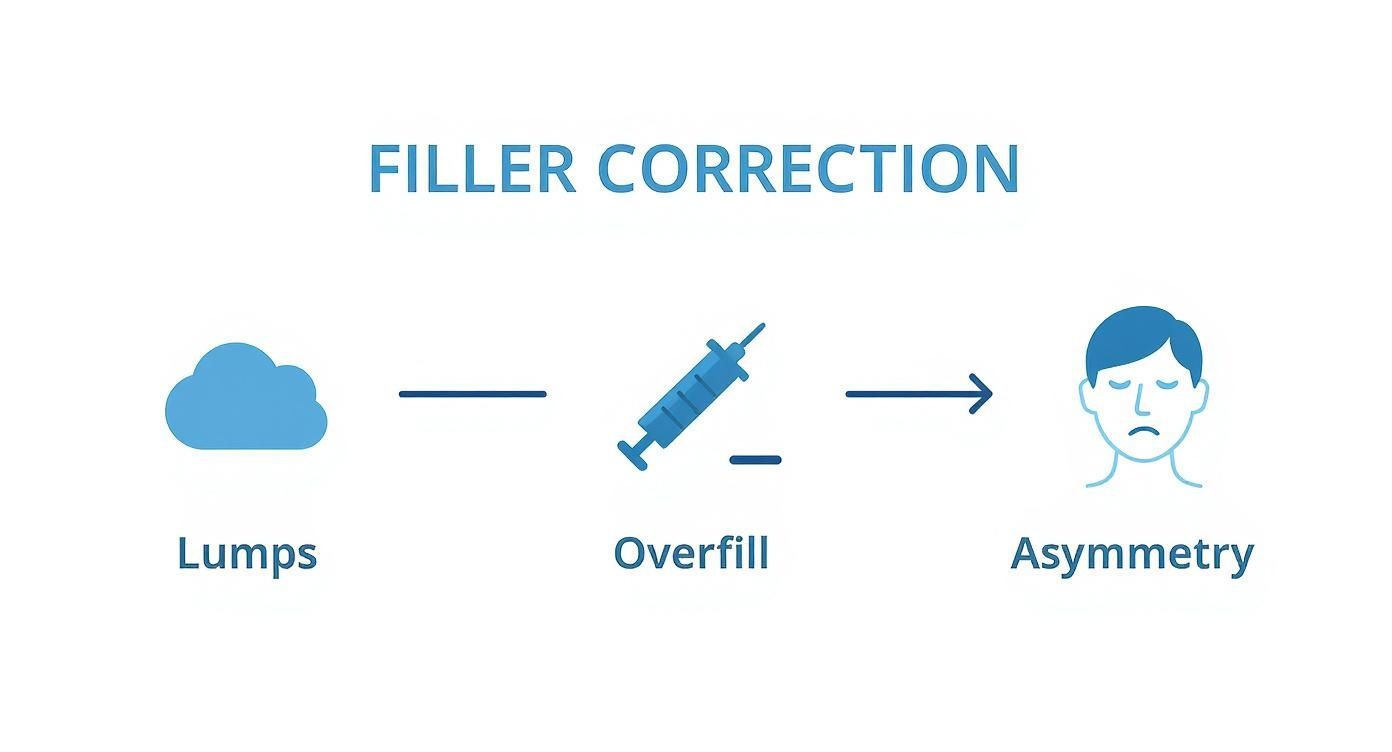
While it shows routine adjustments for things like lumps or asymmetry, it’s a good reminder of the versatility of this enzyme. It’s a tool that can handle both the small tweaks and the major crises.
Broader Medical Applications Beyond Aesthetics
Hyaluronidase has a long history of use in medicine, well beyond the aesthetic clinic. In the UK, it’s licensed primarily to help increase the dispersion and absorption of other injected drugs. Its off-label use for managing filler complications, however, is arguably its most critical function in our field.
Even though vascular occlusion is rare—estimated to occur in just 0.001% of cases—its severity means you have to be ready. Managing this involves using pulsed, high doses of hyaluronidase, often ranging from 450 to 1500 international units (IU), administered until circulation is restored.
But its utility doesn’t stop there. The enzyme has several other fascinating and licensed medical applications:
- Ophthalmic Surgery: It’s often mixed with local anaesthetics for eye surgery. This helps the numbing agent spread more effectively and quickly, making the procedure more comfortable for the patient.
- Hypodermoclysis: This is a technique for giving fluids under the skin when getting IV access is tricky. Hyaluronidase temporarily makes the tissue more permeable, allowing the body to absorb large volumes of fluid with ease.
- Radiology: In some imaging procedures, it helps contrast agents diffuse more evenly through tissues, leading to clearer, more detailed scans.
These applications, along with its potential in other areas like managing visible veins (a topic we cover in our guide to veins gel treatment), truly highlight the enzyme’s wide-ranging medical value.
Hyaluronidase is more than a corrective tool; it is a fundamental component of patient safety. Its presence in a clinic provides a critical safety net, ensuring that practitioners are prepared to manage the unexpected and protect their patients’ wellbeing.
From reversing a potentially blinding vascular event to simply helping an anaesthetic work better, hyaluronidase has cemented its place as a powerful and essential enzyme in modern medicine. Its dual personality—as both a precision tool for aesthetic refinement and an emergency drug for critical situations—makes it absolutely indispensable.
Understanding Treatment Protocols and Safety
https://www.youtube.com/embed/ZIEZ3ehRqus
Using hyaluronidase is a real blend of art and science. It’s not just about following a recipe; it’s about having a deep understanding of the protocols and, above all, an absolute commitment to patient safety. The whole process—from preparation and dilution to the actual injection technique—has to be adapted for every single person and situation.
Think about it: tackling a small, stubborn filler lump is a world away from dealing with an urgent vascular occlusion. For a minor correction, you’d likely use a very dilute solution for a subtle tweak. But in an emergency, you need a high-dose, concentrated flood of the enzyme to clear a blocked vessel and restore blood flow, fast. It’s this kind of clinical judgement that separates good outcomes from bad ones.
The Crucial Role of Allergy Testing
Before a single drop is injected, safety has to be your number one priority. While a true allergy to hyaluronidase is rare, it can happen, and the reactions can be severe. That’s why a patch test (also known as an intradermal test) is a non-negotiable first step for many of us, especially when it’s not a frantic emergency.
It’s a straightforward test: a tiny amount of hyaluronidase is injected into the forearm, and you watch the area for about 30 minutes. If a big, itchy welt pops up, that’s a red flag for a potential allergy, and you absolutely should not proceed. Skipping this simple check in a non-urgent case is an unnecessary gamble.
A proactive approach to safety is what builds patient trust and defines professional practice. Spending a few minutes on a patch test can prevent a serious adverse event, reinforcing that the patient’s wellbeing always comes first.
Understanding Dosing and Administration
This is where a practitioner’s experience really comes into play because there’s no universal dose for hyaluronidase. The right amount hinges entirely on what you’re trying to achieve, the brand of filler you’re dissolving, and the patient’s unique anatomy.
- For Minor Corrections: You might only need 5-10 units to smooth out a tiny lump or soften a sharp edge.
- For Full Dissolving: To reverse a larger treatment, like overfilled lips, you could be looking at 100-200 units or more, often spread across a couple of sessions.
- For Emergencies: A vascular occlusion protocol is an all-hands-on-deck situation. We start with a high-dose flood, often 500-1500 units, and repeat it as needed until the blockage is cleared.
Data from UK practitioners confirms that hyaluronidase is the go-to for managing filler complications. For vascular occlusions, concentrations typically range from 150 IU/ml to 750 IU/ml, with doses administered frequently until the problem is solved. What’s really telling is that 73% of users reported having no set maximum dose; they simply continued treatment until they saw a clinical resolution. It just goes to show how much relies on practitioner judgement. You can read more about these findings on hyaluronidase usage in the UK.
Navigating Side Effects and Post-Treatment Care
Even when the procedure goes perfectly, you can expect some side effects. It’s important to prepare patients for some temporary swelling, redness, and bruising around the injection sites. These usually peak in the first 24 hours and then settle down over a few days.
Clear aftercare instructions are essential for a smooth recovery. The advice is generally pretty simple:
- Avoid strenuous exercise for 24-48 hours to keep swelling to a minimum.
- Steer clear of alcohol and high heat, like saunas or steam rooms, for a day or two.
- Don’t massage the area, as this could spread the enzyme to places you don’t want it.
Proper post-treatment care is just as critical in aesthetic work as it is in other procedures, like those we discuss in our guide on what is mesotherapy, to get the best possible results.
Finally, for any clinic offering these treatments, protecting patient health information is paramount. This means using robust HIPAA risk assessment tools to ensure data is always secure. It’s another layer of professional responsibility that we can’t afford to overlook in a modern clinical setting.
Your Hyaluronidase Questions, Answered
As hyaluronidase becomes a staple in modern aesthetics, it’s natural for questions to pop up. Whether you’re a patient or a practitioner, you want clear, reliable information. Let’s tackle some of the most common queries and clear up any confusion.
Does Dissolving Filler With Hyaluronidase Hurt?
Since the treatment involves injections, you should expect some level of discomfort—much like you felt when getting the fillers in the first place. This is a very common concern, and thankfully, practitioners have great methods for making the experience as comfortable as possible.
Many clinicians will mix a local anaesthetic, like lidocaine, directly into the hyaluronidase solution. This numbs the area from the inside out as the treatment is happening. Another popular approach is to apply a high-strength topical numbing cream to the skin beforehand. It’s completely normal to have some tenderness, bruising, or swelling at the injection sites afterwards, but this is usually quite mild and clears up on its own within a few days.
How Quickly Does Hyaluronidase Work?
The speed of hyaluronidase is one of its most impressive features. The moment it’s injected, the enzyme gets straight to work, breaking down the hyaluronic acid filler.
You can often see a noticeable reduction in volume within just a few hours. The catch is that this immediate change is usually hidden by swelling from the injections. The real, final result tends to reveal itself after about 24 to 48 hours, once that initial swelling has gone down. While this rapid action is a lifesaver in emergencies, for routine cosmetic tweaks, it’s always best to wait a full one to two weeks to properly assess the outcome before considering any further adjustments.
While the enzyme acts fast, patience is key to seeing the final, settled result. Allowing the initial swelling to completely go down ensures you can accurately judge the outcome and plan any next steps effectively.
Can Hyaluronidase Affect My Natural Tissues?
This is an excellent question and a very common concern. Hyaluronidase is designed to target hyaluronic acid, but it can’t tell the difference between the HA in a filler and the HA your body produces naturally. So yes, it can temporarily break down some of your body’s own supply.
This might cause a brief dip or a slightly “hollowed” look in the treated area right after the procedure. But here’s the good news: our bodies are constantly making their own hyaluronic acid. The effect is almost always short-lived, with your natural tissue volume bouncing back to normal within 24 to 48 hours.
An experienced practitioner minimises this risk by:
- Using precise, targeted injections to keep the enzyme from spreading too far.
- Administering the lowest effective dose needed to dissolve just the unwanted filler.
- Staging the treatment over multiple sessions, if necessary, for a more controlled, gradual result.
Are There Any Alternatives to Dissolving Fillers?
When it comes to actively removing hyaluronic acid fillers, hyaluronidase is in a league of its own. For an immediate fix, and particularly in an emergency like a vascular occlusion, it is the only proven and effective solution.
There are no other products or techniques that can safely and reliably break down HA fillers once they’re in the tissue. Attempting to massage or squeeze out filler is strongly discouraged and almost never works. The only other real “alternative” is to wait. HA fillers aren’t permanent, and your body will naturally metabolise them over several months to a year or more. If the issue is minor and not causing complications, patience is an option—but it’s not a solution for a quick correction.
For more detailed answers to your questions, you can always explore a broader range of topics in our comprehensive FAQ section. We cover everything from product specifics to general skincare advice to help you on your journey.
At Beauty Page, we provide practitioners and skincare enthusiasts with professional-grade formulations to achieve outstanding results safely. Explore our curated selection of advanced aesthetic solutions, including high-purity hyaluronidase, to elevate your practice or personal care routine. Discover our full range and find the perfect products for your needs at https://beautypage.co.uk.