Free shipping £150+ Orders
Supplements for Hair Thickness That Actually Work
The journey to thicker hair genuinely starts from the inside out. While we spend a lot of time on topical treatments, targeted supplements for hair thickness can supply the fundamental nutrients your hair follicles are crying out for. Think of it as reinforcing your hair care strategy from within, filling in the nutritional gaps that even a healthy diet might miss.
Why Your Diet Is the Foundation for Thicker Hair
Dealing with thinning hair can be incredibly frustrating, but if you’re going through it, you’re certainly not alone. It’s a widespread issue here in the UK, affecting an estimated 8 million women and 6.5 million men. This just goes to show how common and deeply personal the desire for fuller, thicker hair really is.
While things like genetics and hormones have a huge say in your hair’s destiny, nutrition is one area where you have real control.
The Follicle Factory Analogy
I often ask clients to picture their hair follicles as tiny, bustling factories. Their one job, 24/7, is to produce strong, healthy hair strands. And just like any factory, they need a steady stream of raw materials to keep the production line moving smoothly. Those materials are the vitamins, minerals, and proteins you get from your food.
If your diet is lacking, these little factories run into a supply chain crisis. Production slows right down, the quality of the hair they produce drops, and the entire growth cycle can get thrown off kilter. The result? Weaker, thinner strands that are more likely to shed.
It’s crucial to remember that your body sees hair as non-essential. When vital nutrients are in short supply, they’re diverted to your essential organs—like your heart and brain—first. Your hair follicles are left to manage with the leftovers.
Bridging the Nutritional Gaps
This is precisely where well-chosen supplements for hair thickness make a difference. They act as a nutritional safety net, stepping in to bridge those dietary gaps and ensure your “follicle factories” are fully stocked. A quality supplement delivers a concentrated dose of the most important building blocks for healthy hair.
- Vitamins: These are essential for healthy cell growth and maintaining a supportive scalp environment.
- Minerals: Key players in regulating hormones and ensuring a good supply of oxygen reaches the follicles.
- Proteins & Amino Acids: These are the direct components of keratin, the protein that makes up more than 90% of each hair strand.
It’s important to have realistic expectations, though. Supplements aren’t a magic wand. They are one vital piece of a much larger puzzle. For those wanting to really dial in their diet, it can be useful to look into understanding a macro diet, which is all about balancing these key nutrients for your overall health. Getting the right nutrients on board is a foundational step, and you can discover more about finding the right https://beautypage.co.uk/supplements-for-you/ in our detailed guide.
The Building Blocks Your Hair Needs to Thrive
To get a real handle on which supplements for hair thickness are worth your attention, we need to go deeper than just a list of ingredients. Let’s look at the specific jobs these nutrients do. Think of it like building a house: for a strong, sound structure, you need a skilled team and the right materials. Your hair is no different.
Each nutrient acts like a specialist on your hair’s construction site. Some are the foremen, some drive the delivery lorries, and others are the raw materials themselves. When this team works in perfect harmony, the result is thicker, more resilient hair. Let’s meet the key players.
Biotin and B Vitamins: The Master Builders
Biotin, or Vitamin B7, gets a lot of hype in the hair world, and for good reason. It’s like the project foreman, absolutely essential for producing keratin—the very protein that makes up the physical structure of your hair. While a true deficiency is rare, a shortfall can directly lead to hair thinning.
Other B vitamins play crucial supporting roles too. Folate (B9) and B12, for example, are vital for making red blood cells. These cells are the couriers, carrying oxygen and nutrients straight to your scalp and follicles to fuel the whole growth process.
Iron: The Oxygen Supply Line
If biotin is the foreman, then iron is the fleet of delivery lorries. Its main job is to help form haemoglobin in your red blood cells. Haemoglobin is the molecule responsible for ferrying oxygen from your lungs to every single cell in your body, including those highly active hair follicles.
When iron levels drop, this critical oxygen supply line falters. Your follicles essentially get starved of the energy they need to grow, which can push them into the shedding phase far too early. Iron deficiency, or anaemia, is a well-known cause of diffuse hair thinning, especially in women.
The diagram below shows the three core nutritional pillars—vitamins, minerals, and proteins—that are fundamental for robust hair growth.
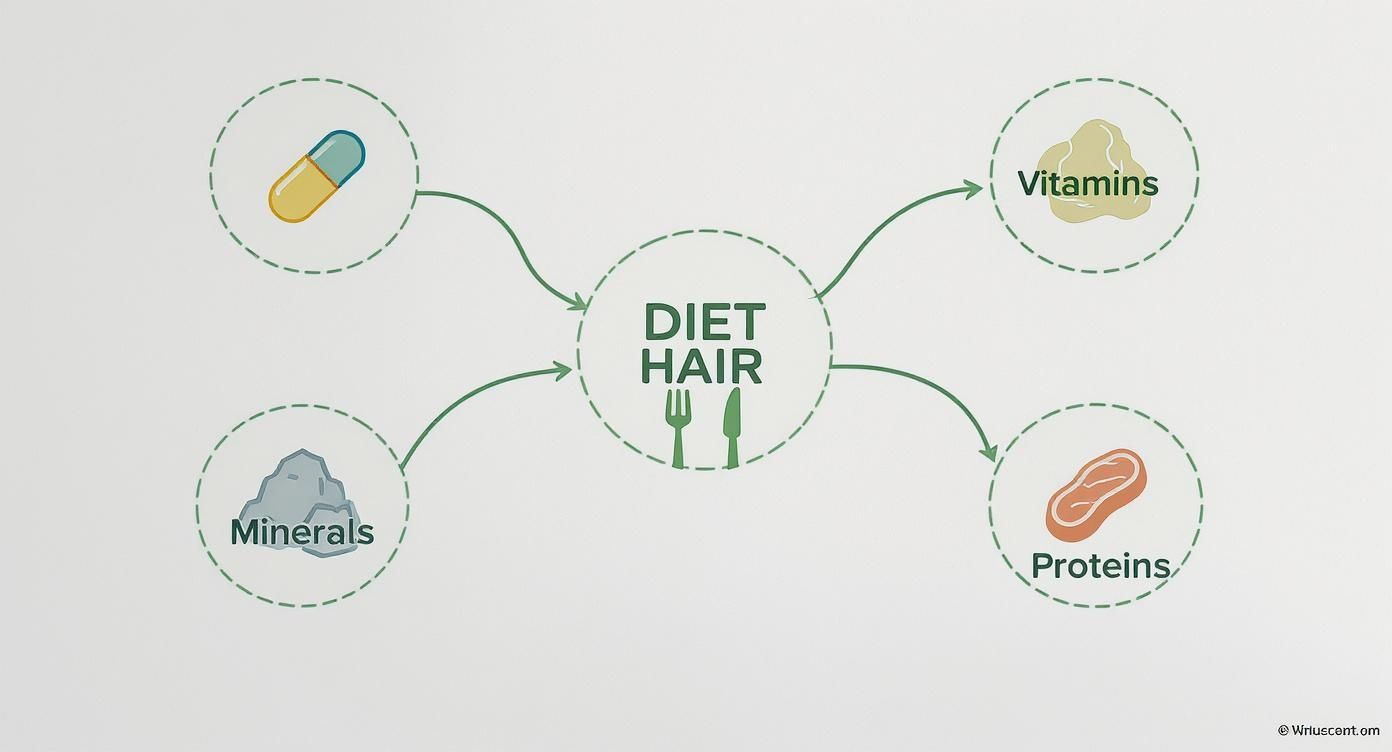
This visual brings it all together, highlighting how a balanced intake from these three groups provides the complete toolkit your body needs to build and maintain healthy hair.
Zinc: The Essential Repair Crew
Every building site needs a maintenance crew, and in your body, that’s zinc. This mineral is a linchpin for hair tissue growth and repair. It also helps keep the oil glands around the follicles working properly, which is key for a healthy scalp environment.
When zinc is in short supply, it can disrupt the hair growth cycle and trigger shedding. Think of zinc as the nutrient that maintains the structural integrity of the hair follicle, preventing it from becoming weak and prone to breakage.
A key takeaway here is that these nutrients are all interconnected. For instance, Vitamin C doesn’t just help produce collagen (another vital hair protein); it also dramatically improves your body’s ability to absorb iron from your diet.
Vitamin D: The Follicle Activator
Imagine Vitamin D as the planner who scouts and approves new building sites. This nutrient’s unique role is to help create new follicles—the tiny pores in the scalp where new hair can grow.
When you don’t have enough Vitamin D, existing follicles can become dormant, slowing or even stopping new hair growth in its tracks. While our main source is sunlight, many people in the UK have insufficient levels, particularly during the winter, making supplementation a very practical consideration.
To help you connect these concepts to your diet, here is a quick summary of the most important nutrients.
Key Supplements and Their Role in Hair Thickness
| Nutrient | Primary Role in Hair Health | Common Food Sources |
|---|---|---|
| Biotin (B7) | Essential for keratin production, the main protein in hair. | Eggs, nuts (almonds, walnuts), seeds, sweet potatoes, spinach. |
| Iron | Carries oxygen to hair follicles, fuelling growth. | Red meat, lentils, spinach, tofu, fortified cereals. |
| Zinc | Supports hair tissue growth, repair, and scalp health. | Oysters, beef, pumpkin seeds, lentils, chickpeas. |
| Vitamin D | Helps create new hair follicles and activates dormant ones. | Oily fish (salmon, mackerel), mushrooms, fortified milk and cereals, sunlight. |
| Amino Acids | The direct building blocks of keratin. | Meat, fish, dairy, eggs, quinoa, beans. |
| Omega-3s | Reduce inflammation and nourish the scalp and follicles. | Oily fish (salmon, sardines), flaxseeds, chia seeds, walnuts. |
This table serves as a handy reference, but remember that for many people, supplementation is the most reliable way to ensure optimal levels for hair health.
Key Proteins and Fats: The Raw Materials
Finally, no house gets built without bricks and mortar. For your hair, the most fundamental materials are amino acids (from protein) and healthy fats.
- Amino Acids: Nutrients like L-lysine and L-methionine are the literal building blocks of keratin. A diet low in protein forces your body to ration it, and since hair isn’t a vital organ, its growth is one of the first processes to be put on the back burner.
- Omega-3 Fatty Acids: These fats, found in oily fish and flaxseeds, are fantastic for scalp health. They help to reduce inflammation and nourish follicles, creating the perfect foundation for strong growth.
- Silicon: This trace mineral contributes to hair strength and elasticity, helping to reduce brittleness. While found in some foods, certain forms are more bioavailable. This is why a targeted supplement like Basic Organic Silicon 1% can be a great option for those looking to reinforce their hair’s internal structure.
Once you understand these distinct roles, you can look at a supplement label with new eyes. You’re no longer just seeing a list of ingredients; you’re seeing a specialised team assembled to build thicker, healthier hair from the inside out.
Separating Scientific Fact from Marketing Hype

In the beauty and wellness world, it’s easy to get lost in a sea of clever marketing. When it comes to hair supplements, the market is packed with dramatic before-and-after photos and bold promises. But can a pill really give you thicker hair? Let’s take a closer look at the science.
Studying how supplements affect our hair is surprisingly tricky. Unlike tightly controlled drug trials, supplement studies often have smaller sample sizes, use different formulas, and rely on people reporting their own results. This makes it hard to get clear-cut answers, which is why a compelling personal story isn’t the same as solid scientific proof.
Our goal here is to give you the tools to look past the hype and become a more discerning consumer.
Understanding the Evidence for Key Ingredients
Not every ingredient touted for hair health has the same scientific backing. Some nutrients have a clear, well-established role in the hair growth cycle, while others are supported by much shakier evidence. Knowing the difference is key to setting realistic expectations.
Let’s break down the science behind some of the most common ingredients you’ll find in supplements for thicker hair.
- Iron: The connection between iron deficiency (with or without anaemia) and hair shedding—a condition called telogen effluvium—is strongly established by clinical research. For people with low iron levels, supplementation is a proven way to help restore normal hair growth.
- Biotin (Vitamin B7): This is probably the most famous “hair vitamin” on the shelf. While it’s vital for producing keratin, a true biotin deficiency is incredibly rare for anyone with a reasonably balanced diet. Taking extra biotin is most effective for the few people who are genuinely deficient; for everyone else, the evidence that it boosts hair thickness is pretty limited.
- Zinc: Much like iron, the link between zinc deficiency and hair loss is well-documented. If thinning is caused by a lack of zinc, supplementation is a highly effective solution.
This really gets to the heart of the matter: supplements deliver the best results when they fix a specific nutritional gap. It’s why they should be seen as one part of a bigger picture, which can sometimes include treatments like those we explore in our guide to the shocking truths about hair mesotherapy.
Examining Promising but Less Proven Ingredients
Beyond the heavy hitters, there are a few other ingredients showing real promise, even if the research is still in its earlier stages. It’s worth knowing about them, but it’s also important to keep a balanced perspective.
Collagen Peptides
Collagen is a protein packed with the amino acids your body uses to build keratin, the very stuff your hair is made of. The idea is that taking a collagen supplement gives your body more of these essential building blocks.
While direct proof linking collagen supplements to increased hair thickness is still emerging, studies have found it can improve skin elasticity and hydration. A healthier, more supple scalp is the ideal foundation for robust hair growth.
Saw Palmetto
This herbal extract is popular for its potential to interact with the hormonal pathways involved in hair loss. It’s thought to inhibit 5-alpha-reductase, the enzyme that converts testosterone into dihydrotestosterone (DHT).
DHT is the main culprit behind pattern hair loss (androgenetic alopecia), as it causes hair follicles to shrink over time. While some smaller studies suggest saw palmetto might help slow this down, the results aren’t as conclusive as they are for pharmaceutical drugs. Still, many see it as a promising natural option for supporting hair health.
By getting to grips with the level of scientific backing for each ingredient, you can start to see past the marketing noise. This lets you focus on supplements formulated with nutrients that have a proven role in hair biology, especially if you’re trying to correct a known deficiency.
How to Choose a High-Quality Hair Supplement
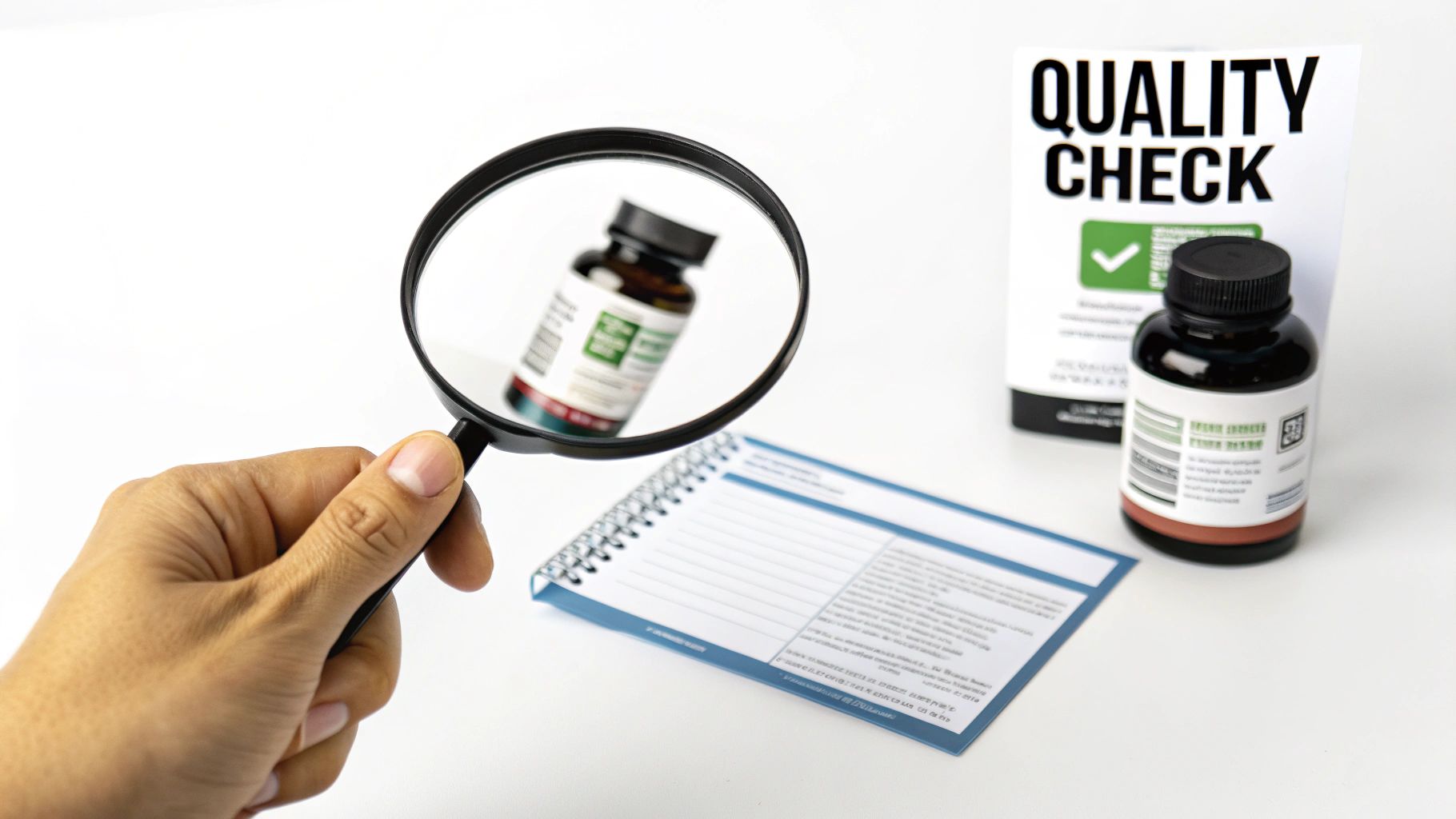
Stepping into the supplement aisle can feel overwhelming. You’re faced with a wall of bottles, all promising thicker, healthier hair. It’s no surprise, really. The UK hair growth supplement market is booming, valued at USD 377.2 million in 2023 as more of us hunt for safe, transparent, and natural options.
But with so much choice, how do you separate the genuinely effective products from the marketing hype? This guide will give you the practical know-how to cut through the noise, read labels like a pro, and invest in a supplement that truly supports your hair health goals.
Decode the Supplement Label
Forget the glossy marketing on the front of the bottle; the real story is on the back. A quality supplement label is completely transparent, giving you the precise details about what’s inside. Here’s what you need to look for.
Focus on Dosage and Bioavailability
An ingredient list is one thing, but the form and dosage of each nutrient are what actually count. Simply having biotin or iron in a pill isn’t enough. We need to know if the body can actually absorb and use it—a concept known as bioavailability.
A thoughtful formulation will always prioritise superior, highly bioavailable forms of key nutrients.
- Take iron, for example: Many supplements use ferrous sulphate, a common form that can be quite harsh on the stomach. A much better choice is iron bisglycinate, a chelated form that’s both gentler and absorbed far more efficiently.
- The same goes for zinc: Look for forms like zinc picolinate or citrate. Research suggests these are taken up by the body much more effectively than the cheaper zinc oxide or sulphate alternatives.
When a brand invests in these premium forms, it’s a clear sign they’ve formulated the product for maximum impact, not just to tick a box on an ingredient list.
Look for Third-Party Certifications
While the supplement industry in the UK and Europe is regulated, the quality can still vary dramatically from one brand to another. This is where independent, third-party certifications come in. They act as your seal of approval, verifying that what’s on the label is actually in the bottle.
The most crucial certification to look for is GMP (Good Manufacturing Practices). This stamp confirms the product was made in a facility that follows strict quality control standards for purity, potency, and safety. Honestly, it should be a non-negotiable benchmark for any brand you consider.
When you’re weighing up different products, it can be really helpful to see what others are saying. Checking out a detailed review of a specific hair growth supplement like Provillus can give you great insight into its formulation, certifications, and real-world user experiences.
To make things easier, here’s a quick checklist you can use to vet any potential supplement.
Supplement Quality Checklist
Use this table as your guide to cut through the marketing jargon and assess whether a product is worth your investment.
| Quality Factor | What to Look For | Why It Matters |
|---|---|---|
| Label Transparency | A full ingredient list with precise dosages for every single active nutrient. | Hiding behind “proprietary blends” is a red flag. It prevents you from knowing if you’re getting an effective dose. |
| Bioavailable Forms | Nutrients in forms the body can easily absorb (e.g., iron bisglycinate, zinc picolinate, methylcobalamin for B12). | Your body can’t use what it can’t absorb. High bioavailability means you get the full benefit of each ingredient. |
| Third-Party Testing | Certifications like GMP (Good Manufacturing Practices) or seals from independent labs. | This provides unbiased proof that the supplement is pure, potent, and free from contaminants. |
| Clean “Other Ingredients” | A short list, free from unnecessary fillers, artificial colours, and bulking agents (like titanium dioxide). | A long list of fillers often signals a lower-quality product where actives are secondary to manufacturing cost. |
| Realistic Claims | Promises of gradual improvement over 3-6 months, aligning with the natural hair growth cycle. | “Miracle growth overnight” is biologically impossible. Credible brands manage expectations realistically. |
By keeping these points in mind, you can approach your decision with confidence, knowing you’re choosing a product based on substance, not just promises.
Spot the Red Flags
Just as important as knowing what to look for is knowing what to avoid. Certain formulation tricks and marketing tactics should immediately make you sceptical.
1. Proprietary Blends
This is perhaps the biggest warning sign. A “proprietary blend” or “complex” is a smokescreen. It lists a group of ingredients under a single trademarked name but doesn’t tell you the exact amount of each one. This allows companies to bulk out their formulas with cheap ingredients and include only tiny, ineffective amounts of the expensive ones. Always, always choose products with a fully transparent label.
2. Over-the-Top Promises
Be very wary of any supplement that promises “overnight results” or “miraculous growth.” Real, sustainable results take time. You’ll typically need to be consistent for 3 to 6 months to see a noticeable difference, as supplements work in harmony with your body’s natural hair growth cycle. Sensible claims are the hallmark of a credible brand.
3. Unnecessary Fillers and Bulking Agents
Always scan the “other ingredients” list at the bottom of the label. High-quality supplements keep this list as short and clean as possible. A long list of unnecessary fillers like magnesium stearate, artificial colours, or titanium dioxide often points to a lower-quality product.
By applying these simple principles, you can shift from being a hopeful buyer to a truly informed consumer. You’ll be able to confidently choose a hair thickness supplement based on solid science, proven quality, and total transparency. And while you’re focused on hair, remember that overall cellular health is key; you might find it interesting to learn more about glutathione and its role in cellular health, an antioxidant that supports your body’s foundational wellness.
Building Your Complete Hair Thickness Strategy

While targeted supplements for hair thickness provide essential support from within, they truly deliver when they’re part of a bigger picture. Think of your supplement as the fuel, but your overall strategy is the high-performance engine. For the best results, every part has to work together seamlessly.
This means combining smart nutrition with external treatments and mindful lifestyle choices. It’s this synergy that creates the perfect environment for your hair to really flourish. You’re essentially building a robust, multi-layered defence against thinning and a proactive plan for sustained growth.
The Non-Negotiable Foundation: A Balanced Diet
Before any supplement can work its magic, it needs a solid foundation to build on. And that foundation is a consistent, nutrient-dense diet packed with whole foods. Let’s be clear: supplements are there to fill specific nutritional gaps, not to replace a healthy plate.
Your daily meals should always be the primary source of the vitamins, minerals, and proteins your hair follicles are crying out for. Prioritising these food groups ensures your body has a constant supply of the raw materials it needs to produce healthy hair:
- Lean Proteins: Think chicken, fish, eggs, and legumes. They provide the amino acids essential for building strong keratin.
- Leafy Greens: Spinach and kale are powerhouses of iron and vitamin C, a duo that’s vital for getting oxygen to your hair follicles.
- Healthy Fats: Avocados, nuts, and oily fish supply omega-3s, which help to reduce inflammation and nourish the scalp.
When you focus on a whole-foods diet first, you let your chosen supplement do its job much more effectively—topping up key nutrients to the optimal levels needed for serious hair growth.
Combining Internal and External Treatments
A truly effective strategy means tackling hair thickness from two angles at once: from the inside out and the outside in. This is where pairing your oral supplements with proven topical treatments can have a powerful combined effect.
Imagine your supplements are nourishing the “root” of the problem deep inside the follicle. At the same time, topical applications are working directly on the scalp and hair shaft to stimulate and protect. This dual-action approach can seriously amplify your results.
The Inside-Out, Outside-In Principle: Oral supplements deliver key nutrients through the bloodstream right to the hair follicle’s control centre (the papilla). At the same time, topical treatments get to work on the scalp’s surface to prolong the growth phase, improve circulation, and shield the emerging hair strand.
Consider adding one of these evidence-backed topical options to your routine:
- Minoxidil: This is one of the most well-researched topical treatments out there. It works by widening blood vessels in the scalp, which improves blood flow to the follicles and extends the anagen (growth) phase of the hair cycle.
- Caffeine Shampoos: Studies have shown that topical caffeine can help counteract the effects of DHT—the hormone largely responsible for pattern hair loss—right at the follicle, encouraging healthier growth.
This combined approach makes sure you’re supporting every single stage of the hair growth cycle.
Supporting Professional Hair Revitalisation
If you’re exploring clinical solutions, supplements play a crucial supporting role. Professional treatments create the ideal conditions for regrowth, and proper nutrition ensures your body has the resources to make the most of that opportunity.
Take an advanced procedure like Low-Level Laser Therapy (LLLT), for example. LLLT works by stimulating cellular activity within the follicles, encouraging them to get back into the growth phase. Your supplements then provide the specific building blocks—like biotin, zinc, and amino acids—that these newly energised follicles need to construct strong, thick hair fibres. For anyone interested in the latest advancements, you can explore how exosomes for hair revitalisation work in our detailed guide. This is a cutting-edge treatment that also benefits massively from robust nutritional support.
Lifestyle Factors: The Final Piece of the Puzzle
Finally, your daily habits have a huge impact on your hair’s health and thickness. Chronic stress, harsh styling, and poor sleep can all undermine your best efforts, no matter how good your supplements or treatments are.
Integrating these simple lifestyle adjustments is what completes your holistic strategy:
- Stress Management: High cortisol levels can push hair follicles into a premature shedding phase. Bringing in activities like meditation, yoga, or even a daily walk can make a real difference.
- Gentle Styling: Avoid tight hairstyles that pull on the roots and try to minimise the use of high-heat styling tools. When you do use heat, always apply a protectant spray first.
- Scalp Care: Treat your scalp with the same care you give the skin on your face. A regular, gentle massage can boost circulation, and keeping it clean and free from product build-up creates a much healthier environment for growth.
By building this complete strategy, you move beyond just taking a pill. You create a comprehensive system where diet, supplements, treatments, and lifestyle all work in harmony to help you achieve and maintain the thicker, healthier hair you’re after.
Your Questions About Hair Thickness Supplements, Answered
Stepping into the world of supplements for thicker hair can feel a bit overwhelming. With so much conflicting information out there, it’s completely normal to feel unsure about where to begin. We’ve been asked these questions countless times, so we’ve put together some clear, science-backed answers to help you move forward with confidence.
It’s no surprise there’s so much chatter on this topic. The interest in hair supplements is booming. In the UK alone, sales are expected to jump from an estimated £1.03 billion in 2025 to a massive £1.66 billion by 2035. This isn’t just a trend; it’s a reflection of people wanting effective products that genuinely support hair strength from the inside out. You can dive deeper into these figures by checking out the growing haircare supplement market report on futuremarketinsights.com.
More choice is great, but it also means being a savvy consumer is more important than ever.
How Long Until I See Results from Hair Supplements?
This is the big one, the question on everyone’s mind. The honest answer? It takes time, and patience is your best friend here. Hair grows slowly—about half an inch a month on average. For that reason, you’ll need to stick with a supplement consistently for at least three to six months before you can expect to see a real, noticeable difference.
Think of it this way: the nutrients you take today are for the hair that’s just beginning to form inside the follicle. They can’t change the hair that’s already grown. You’re playing the long game, investing in the quality and strength of your future hair. So, it’s vital to align your expectations with that slow and steady biological clock.
Is It Safe to Take Multiple Hair Supplements at Once?
Tempting as it might be to create your own “super-stack” of supplements, it’s generally not a good idea without guidance from a professional. Many hair formulas contain similar ingredients, particularly fat-soluble vitamins like A, D, and E, and minerals like zinc and iron.
Doubling or tripling up on these can easily push you past safe limits and lead to toxicity. For instance, getting far too much vitamin A can, ironically, cause hair loss. An overload of zinc can disrupt your copper absorption and even weaken your immune system.
The smartest path is to choose one well-formulated, comprehensive supplement that covers all the bases. Or, better yet, talk to your doctor. They can run tests to see if you have specific deficiencies that need targeted support.
Are There Side Effects I Should Know About?
Yes, it’s always wise to be aware of potential side effects. Most people handle hair supplements just fine when they stick to the recommended dosage. The problems usually start when people take far more than the label suggests.
Here are a few common examples of what can go wrong with excessive doses:
- High Doses of Biotin: This is a big one. Too much biotin can seriously interfere with lab tests, including those for thyroid and heart conditions, potentially leading to a misdiagnosis.
- Excess Iron: Can wreak havoc on your digestive system, causing anything from constipation and nausea to an upset stomach, especially if taken without food.
- Too Much Zinc: As we mentioned, this can cause a copper deficiency over time, which brings its own set of neurological and blood-related issues.
Should I See a Doctor Before Starting Hair Supplements?
Without a doubt. We always recommend having a chat with your GP or a dermatologist before starting any new supplement. Sometimes, hair thinning isn’t just about nutrition; it can be a sign of an underlying medical condition that a supplement simply can’t fix.
A doctor can order a simple blood test to check for the usual suspects, such as:
- Anaemia (low iron)
- Thyroid problems
- Hormonal imbalances
- Vitamin D deficiency
By getting to the root cause, you and your doctor can create a plan that’s actually targeted to your body’s needs. It’s the difference between guessing and knowing, and it leads to a much more effective and sustainable strategy for achieving the thicker, healthier hair you want.
At Beauty Page, we’re firm believers in a science-first approach to hair and skin health. Feel free to explore our range of professional-grade solutions and supportive supplements, all designed to deliver real, noticeable results. Visit us at https://beautypage.co.uk to build your complete wellness strategy.